Industrial & Commercial Construction: Building More Than Just a Structure
A building is more than steel, bricks and concrete. It is your business taking shape.
For a factory owner, commercial property owner or business owner, a construction project is not simply about creating walls, floors and a roof. The building must ultimately support the way the business operates.
It needs to accommodate people, machinery, storage, movement, services, workflow and future expansion.
That is why industrial and commercial construction requires much more than basic site execution. It requires planning, structural coordination, quality control and a clear understanding of the owners objectives.
From Construction Site to Business-Ready Space
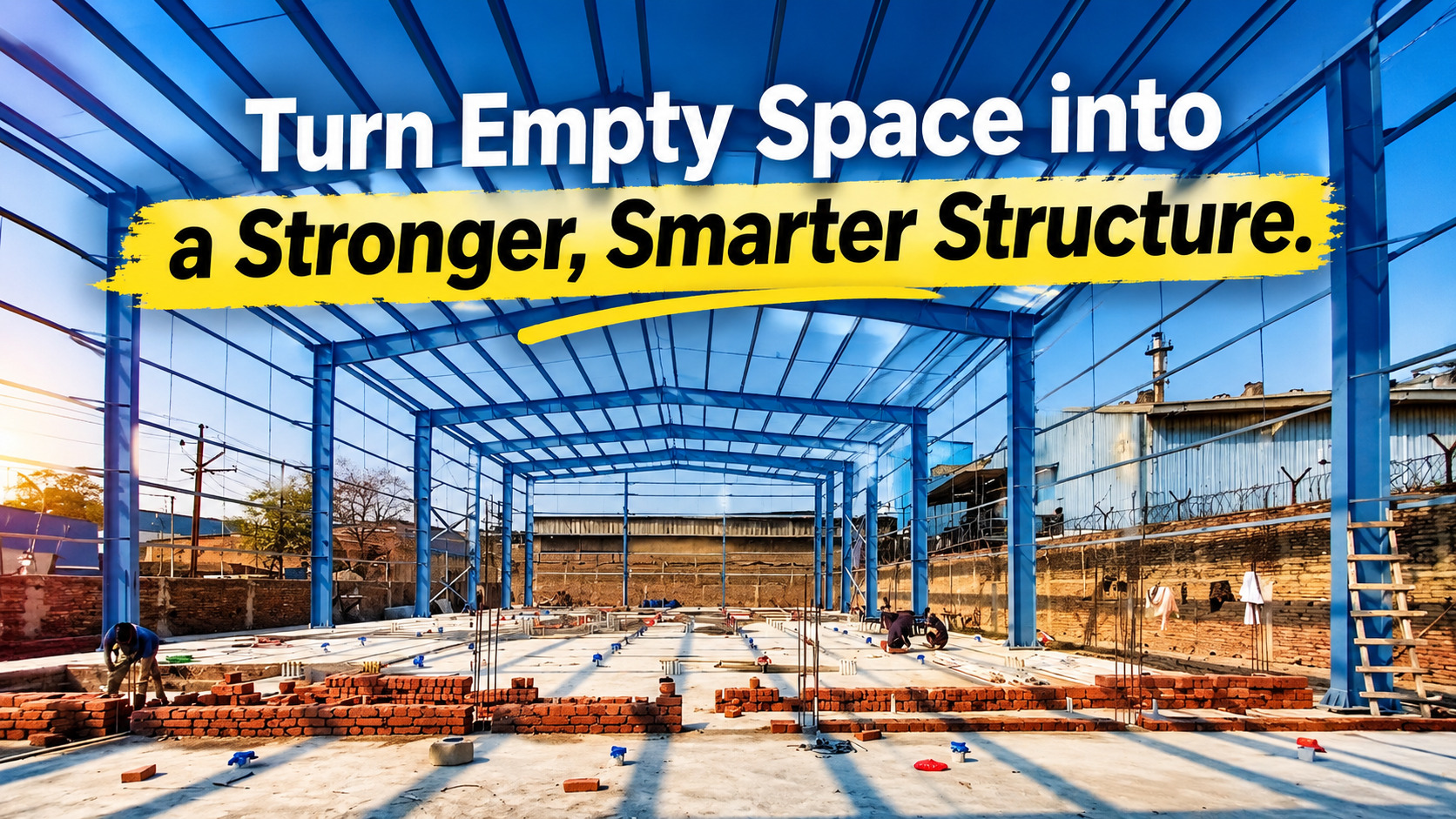
During the early stages of construction, an industrial or commercial building may look like a collection of steel frames, brickwork, columns, slabs and roofing systems.
But these individual components eventually come together to create something much more important: a functional space designed around a business operation.
Every structural element, opening, service route and internal space has a purpose.
The quality of decisions made during construction can therefore have a direct impact on how effectively the completed building performs.
Why Industrial Construction Requires More Than Structural Work
Industrial buildings often have requirements that are very different from conventional residential construction.
Depending on the project, the building may need to accommodate:
- Heavy machinery and equipment
- Large production areas
- Warehousing and storage
- Loading and unloading operations
- Material movement
- Electrical and mechanical systems
- HVAC and ventilation
- Fire-safety systems
- Worker movement and safety
- Future expansion
This means the construction team needs to understand how the building will actually be used before and during execution.
1. Construction Should Start With the Owners Objective
One of the most important decisions in a commercial or industrial project happens before construction begins.
The project team needs to understand what the building is expected to achieve.
For example, a factory may require a different structural and spatial approach compared with an office, warehouse, school or commercial facility.
Important questions can include:
- What will the building be used for?
- What type of machinery or equipment will operate inside?
- How will materials enter and leave the building?
- How much storage space is required?
- What type of electrical load is expected?
- Are specialized services required?
- Will the business expand in the future?
- How should people and vehicles move around the site?
Answering these questions early can help the design and construction team make better decisions.
2. Structural Accuracy Matters From the First Stage
Industrial and commercial structures often involve significant structural requirements.
Steel frames, RCC elements, foundations, slabs, roofing systems and other structural components need to be executed according to the approved design and applicable engineering requirements.
Even a small execution error can create problems later if it affects alignment, dimensions, openings, equipment installation or subsequent construction activities.
That is why structural accuracy and site-level quality control are critical throughout the project.
Every Stage Affects the Next Stage
Construction is a connected process.
Foundation work affects the structure. The structure affects masonry and services. Masonry affects finishes. MEP services affect ceilings and interiors.
A problem introduced during one stage can therefore become much more expensive to correct during a later stage.
3. Coordination Prevents Expensive Rework
Commercial and industrial projects often involve multiple teams working simultaneously.
These can include:
- Architects
- Structural engineers
- Civil teams
- Electrical contractors
- Plumbing teams
- HVAC contractors
- Fire-safety specialists
- Interior and finishing teams
- Equipment suppliers
Without proper coordination, conflicts can occur between different systems.
For example, an opening required for equipment may conflict with a structural element, or an MEP route may interfere with another service.
Resolving these issues before execution is generally much easier than modifying completed work.
4. Construction Quality Is More Than the Final Appearance
A building can look impressive after completion while still having execution issues hidden behind finishes.
Professional construction quality therefore needs to be monitored throughout the project.
Depending on the scope, quality control may include:
- Foundation inspections
- Reinforcement checks
- Shuttering and alignment checks
- Concrete quality control
- Material inspections
- Steel fabrication and erection checks
- Masonry inspections
- Waterproofing checks
- MEP coordination
- Finishing inspections
The objective is not simply to correct defects at the end. It is to identify and prevent problems while they are still manageable.
5. Think About Workflow, Not Just Floor Area
One of the biggest differences between a functional commercial building and an inefficient one is how well the space supports its users.
A factory, warehouse or commercial facility should be planned around movement and workflow.
This can include:
- Raw material movement
- Production workflow
- Equipment placement
- Employee movement
- Storage requirements
- Loading and unloading
- Vehicle circulation
- Maintenance access
- Emergency movement
A building with more floor area is not necessarily a better building.
The real value comes from how effectively that space supports the business.
6. Plan for Future Expansion
Businesses change over time.
A company that needs a particular production capacity today may require additional machinery, storage or workspace in the future.
Where appropriate, future expansion requirements should therefore be considered during the initial planning stage.
This may influence decisions related to:
- Structural capacity
- Building layout
- Utility provisions
- Electrical infrastructure
- Equipment access
- Expansion zones
- Site circulation
Planning for future needs can sometimes be more cost-effective than carrying out major modifications after the building is operational.
7. Why Choosing the Right Contractor Matters
Construction execution can determine whether a well-designed project becomes a successful building.
When selecting an industrial or commercial construction contractor, project owners should evaluate more than the lowest quotation.
Important factors include:
- Relevant project experience
- Technical capability
- Site management systems
- Quality-control procedures
- Project planning
- Resource availability
- Safety practices
- Communication and reporting
- Procurement capability
- Previous project performance
A contractor should be able to demonstrate not only what they can build, but also how they plan to execute it.
8. Avoid the Lowest-Quotation Trap
Cost is naturally one of the biggest considerations in any construction project.
However, comparing contractors only on their final quotation can create problems if the scope, specifications or exclusions are not identical.
A lower quotation may sometimes exclude important items or use different assumptions about materials, finishes, services or execution.
Before comparing prices, project owners should ensure that quotations are based on a clearly defined scope and specifications.
The cheapest quotation is not always the lowest-cost project.
9. From Drawings to Site Execution
Construction drawings provide the technical direction for a project, but successful execution requires continuous coordination between drawings and actual site conditions.
Site teams need to verify dimensions, levels, materials, sequencing and other requirements before proceeding with critical activities.
When site conditions differ from the assumptions made during planning, the issue should be reviewed by the appropriate technical team rather than being resolved through informal modifications.
This discipline helps maintain the relationship between design intent and actual construction.
10. The Real Meaning of Turnkey Construction
For many business owners, coordinating multiple contractors can become difficult.
A turnkey approach can simplify project management by placing multiple aspects of the construction process under coordinated responsibility.
Depending on the project scope, turnkey construction may involve coordination of:
- Planning
- Civil construction
- Structural work
- MEP services
- Interior finishes
- Procurement
- Quality control
- Testing and commissioning
- Project handover
The exact scope depends on the contract and project requirements, so owners should always clearly define what is included before signing an agreement.
How Saluja Contracts Approaches Industrial & Commercial Construction
At Saluja Contracts, we believe construction should begin with an understanding of the clients business objective.
Our approach focuses on combining planning, technical coordination, site execution, quality control and project management to create spaces that are designed around their intended use.
Our capabilities include:
- Industrial construction
- Factory construction
- Commercial construction
- Institutional construction
- Turnkey construction
- Building renovation
Explore our construction services to learn more about our project capabilities.
What Makes a Business-Ready Building?
A successful commercial or industrial building should not be judged only by its appearance.
A more useful question is:
Does the building help the business operate efficiently?
A business-ready building should ideally provide the right combination of:
- Structural reliability
- Functional space planning
- Efficient workflow
- Appropriate services
- Safety
- Durability
- Maintainability
- Future adaptability
When these elements are considered together, construction becomes an investment in business infrastructure rather than simply a physical asset.
Frequently Asked Questions
What is industrial construction?
Industrial construction involves planning and building facilities designed for industrial operations such as manufacturing, production, warehousing, processing and related activities. These projects often have specialized structural, MEP, equipment and workflow requirements.
What is the difference between commercial and industrial construction?
Commercial construction generally focuses on buildings such as offices, retail spaces and commercial facilities, while industrial construction commonly involves factories, warehouses, manufacturing facilities and other operational buildings. The exact requirements depend on the intended use of the facility.
How do I choose an industrial construction contractor?
Review the contractors relevant experience, technical capability, previous projects, quality-control systems, project management approach, safety practices, resources and scope transparency before making a decision.
Why is project coordination important in industrial construction?
Industrial projects often involve structural systems, machinery, electrical services, HVAC, fire protection and other specialist systems. Coordination helps reduce clashes, rework and execution delays.
Is turnkey construction suitable for factory projects?
A turnkey approach can be useful when an owner wants coordinated responsibility across multiple construction disciplines. However, the exact scope and responsibilities should be clearly defined in the contract before work begins.
Conclusion: Build for the Business, Not Just the Building
Every industrial or commercial building begins as a drawing, a site and a business objective.
What transforms those elements into a successful facility is planning, engineering, coordination, disciplined execution and attention to detail.
Because a building is not simply a collection of steel, bricks and concrete.
It is the physical foundation of your business operations.
Whether you are planning a factory, warehouse, office, institutional building or commercial facility in Delhi NCR, the right construction approach can help turn your investment into a space that is functional, durable and ready for the future.
Planning your next industrial or commercial construction project?
Contact Saluja Contracts to discuss your project requirements.