Building your first commercial property is a major investment. From selecting the right plot and preparing the design to obtaining approvals, managing construction costs, and ensuring quality execution, every decision can affect the final outcome.
For plot owners, architects, developers, and business owners in Delhi NCR, understanding the commercial building construction process before starting work can help reduce delays, control costs, and avoid expensive mistakes.
A successful commercial building is not simply about putting up a structure. It requires proper planning, design, approvals, budgeting, contractor selection, quality control, and project management.
1. Start With Planning and Feasibility
Before construction begins, evaluate whether the proposed commercial development is technically and financially feasible.
Important factors include:
- Plot size and dimensions
- Soil condition and site investigation
- Permissible FAR/FSI
- Ground coverage
- Building setbacks
- Permitted building height
- Parking requirements
- Fire-safety requirements
- Intended building usage
- Available utilities and services
- Estimated construction cost
A proper feasibility study can identify site limitations before significant money is committed to detailed design and construction.
2. Conduct Soil Investigation Before Foundation Design
The foundation is one of the most important parts of a commercial building. Foundation requirements should be based on actual site conditions rather than assumptions.
A soil investigation can provide engineers with important information about:
- Soil bearing capacity
- Different soil layers
- Groundwater conditions
- Settlement characteristics
- Foundation depth considerations
- Site-specific risks
The same type of commercial building can require different foundation solutions depending on soil conditions, structural loads, and site characteristics.
3. Finalize the Architectural and Structural Design
Once feasibility has been established, work with qualified professionals to prepare the architectural and structural design.
A commercial project may require coordination between:
- Architectural design
- Structural engineering
- Electrical systems
- Plumbing
- HVAC
- Fire protection
- Mechanical services
- Accessibility requirements
All major disciplines should be coordinated before construction progresses significantly.
Coordinate MEP Services Early
Electrical conduits, plumbing lines, HVAC systems, fire-fighting services, shafts, equipment spaces, and ceiling requirements should be coordinated with the architectural and structural design.
Better coordination before construction can reduce clashes, rework, material wastage, and unnecessary delays on site.
4. Obtain the Required Approvals
Commercial construction involves more than physical site execution. Depending on the location, building use, size, and applicable regulations, different approvals, permissions, and NOCs may be required.
These may involve requirements related to:
- Building plans
- Fire safety
- Environmental requirements
- Utilities
- Structural safety
- Land use
- Local development regulations
The exact requirements depend on the project and jurisdiction. Your architect, consultants, and project team should establish the applicable approval requirements before major construction activities begin.
5. Prepare a Realistic Construction Budget
A commercial construction budget should cover much more than cement, steel, bricks, and labour.
Your budget should consider:
- Civil construction
- Structural work
- Steel and reinforcement
- Masonry
- Flooring
- Doors and windows
- Electrical work
- Plumbing
- HVAC
- Fire-fighting systems
- Waterproofing
- False ceilings
- Painting and finishes
- External development
- Professional fees
- Approvals and statutory costs
- Contingency
Prepare a Detailed BOQ
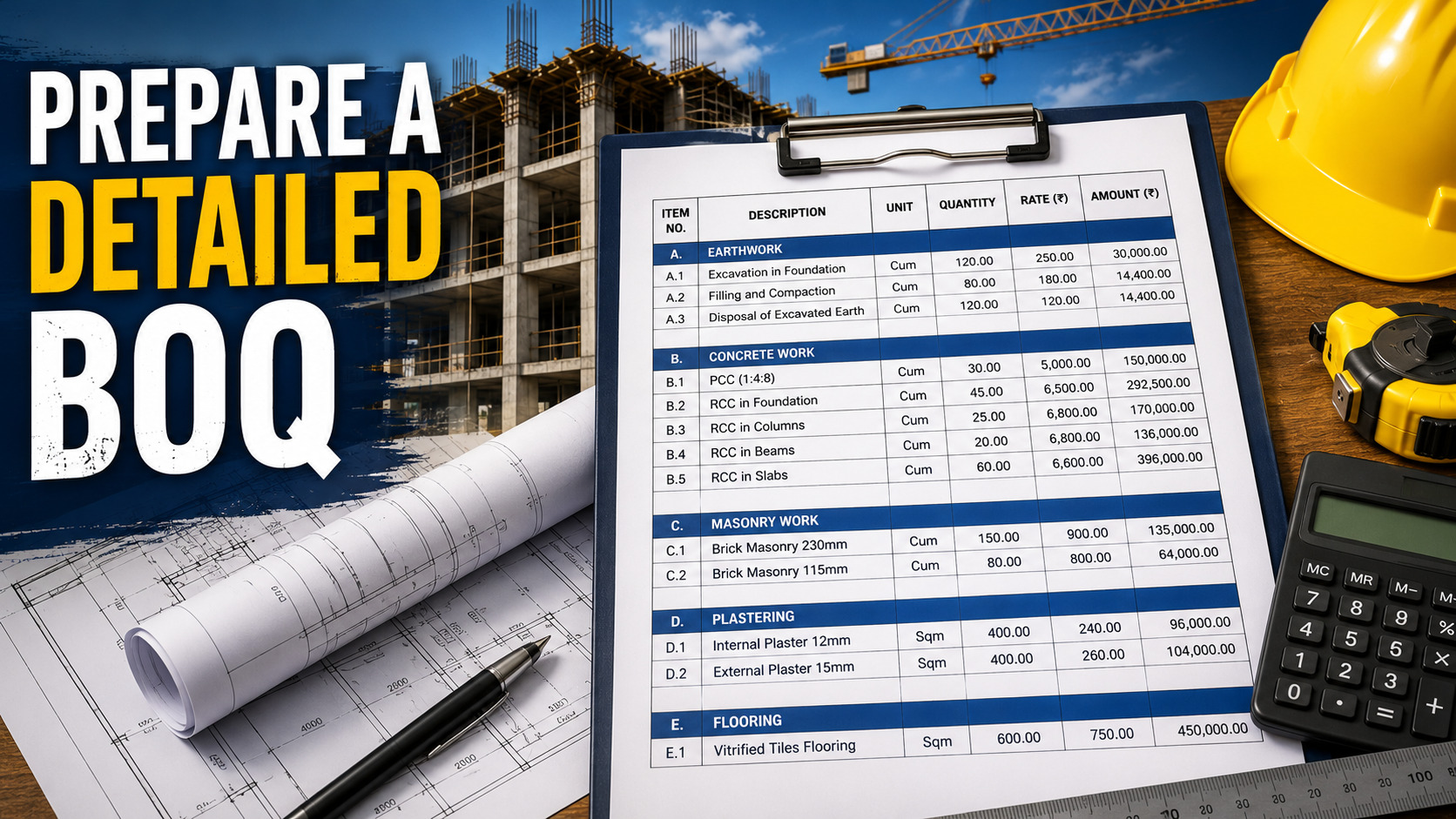
A detailed Bill of Quantities (BOQ) helps define the scope and quantities of work before execution. It also provides a better basis for comparing contractor quotations.
Instead of asking only, How much will the building cost?, ask:
Exactly what work, materials, specifications, quantities, and services are included in the quotation?
This approach can help reduce misunderstandings and unexpected variations later.
6. Choose the Right Commercial Construction Contractor
Selecting a contractor only because they offered the lowest quotation can become an expensive mistake.
Before appointing a contractor, evaluate:
- Relevant project experience
- Previous commercial projects
- Technical capabilities
- Site management team
- Quality-control procedures
- Safety practices
- Resource and execution capability
- Procurement systems
- Project scheduling
- Communication process
- Contract terms and scope clarity
Visit Previous Projects
If possible, visit completed or ongoing projects handled by the contractor. Look at the actual workmanship, site organization, material storage, supervision, safety practices, and overall execution.
A contractors execution capability can be more important than simply having the lowest initial quotation.
7. Establish a Clear Construction Schedule
A commercial construction project involves many activities that depend on each other.
A typical sequence may include:
Site Preparation → Foundation → RCC Structure → Masonry → MEP → Plastering → Flooring → Finishes → Testing → Handover
Several activities can also run simultaneously when properly planned and coordinated.
A project schedule should define:
- Activity duration
- Activity dependencies
- Procurement timelines
- Material delivery dates
- Labour requirements
- Inspection milestones
- Approval dates
- Testing and commissioning
- Handover targets
Monitor the Critical Path
Some activities have very little flexibility. If these activities are delayed, the entire project timeline can be affected.
Identifying critical activities early allows the project team to focus resources where they matter most.
8. Focus on Quality Control During Construction
Quality cannot simply be added at the end of a project. It must be controlled throughout construction.
Important quality-control activities may include:
- Reinforcement inspections
- Shuttering and alignment checks
- Concrete quality checks
- Material testing
- Proper concrete compaction
- Concrete curing
- Waterproofing inspections
- Masonry quality checks
- MEP testing
- Finishing inspections
Before concrete is poured, reinforcement, cover, formwork, dimensions, embedded items, and other applicable requirements should be checked by the responsible project team.
9. Plan Procurement Before Materials Become Critical
Material procurement is one of the hidden causes of commercial construction delays.
Long-lead materials should be identified and planned well in advance.
These may include:
- Elevators
- HVAC equipment
- Electrical panels
- Fire-fighting equipment
- Specialized façade materials
- Doors and hardware
- Customized finishes
A procurement schedule should be connected to the overall construction programme.
If a critical material takes several weeks to manufacture or deliver, ordering it only when the site requires it can push other activities backwards.
10. Maintain Strong Site Supervision
Even a good design can result in poor construction if execution is not properly supervised.
Regular site supervision helps identify issues before they become expensive to correct.
The project team should monitor:
- Workmanship
- Material quality
- Drawing compliance
- Safety
- Construction progress
- Labour productivity
- Material storage
- Site housekeeping
- Coordination between contractors
11. Maintain Proper Construction Documentation
Good construction management is not only about what happens physically on site. It also requires accurate project documentation.
Important records may include:
- Approved drawings
- BOQ
- Work orders
- Material approvals
- Inspection reports
- Test reports
- Site instructions
- Progress reports
- Measurement records
- Variation records
- Meeting minutes
- Site photographs
Proper documentation helps reduce misunderstandings and provides a clear record of project decisions.
12. Plan Testing, Commissioning and Handover
A commercial project does not end simply because the physical construction appears complete.
Before handover, applicable systems and finishes should be inspected, tested, and commissioned.
Depending on the project, this may include:
- Electrical testing
- Plumbing testing
- HVAC commissioning
- Fire-system testing
- Elevator commissioning
- Waterproofing checks
- Finishing inspections
- Snag-list closure
- Handover documentation
Common Mistakes to Avoid When Building a Commercial Property
Some of the most expensive construction mistakes happen because important decisions are made too quickly.
- Starting without proper feasibility
- Ignoring soil investigation
- Changing designs during execution
- Selecting contractors only on price
- Using an unclear BOQ
- Delaying procurement
- Poor coordination between consultants
- Weak site supervision
- Skipping quality inspections
- Ignoring waterproofing
- Underestimating MEP requirements
- Starting work without understanding applicable approvals
The objective should not simply be to achieve the lowest initial construction cost. The goal should be to achieve the right balance between cost, quality, timeline, functionality, safety, and long-term performance.
Why Choose Saluja Contracts?
At Saluja Contracts, we focus on structured project planning, coordinated execution, quality control, and transparent project management.
Our experience covers commercial, institutional, industrial, educational, renovation, and turnkey construction projects.
For building owners and developers planning a project in Delhi NCR, the right construction partner can help coordinate design, procurement, execution, quality control, and project delivery.
Planning your first commercial building? Connect with Saluja Contracts to discuss your construction requirements.
Frequently Asked Questions
How long does it take to build a commercial building?
The timeline depends on building size, design complexity, approvals, site conditions, procurement, labour availability, structural system, and finishing requirements. A realistic schedule should be prepared after the project scope and design are sufficiently defined.
What is the most important step before commercial construction?
Proper feasibility, site investigation, design coordination, budgeting, and approval planning should be completed before major construction activities begin.
How should I choose a commercial construction contractor?
Evaluate relevant experience, previous projects, technical capability, site management, quality-control procedures, safety practices, transparency, and the clarity of the contractors quotation and scope.
Why is a BOQ important in commercial construction?
A BOQ defines quantities and scope of work and provides a structured basis for estimating, comparing quotations, procurement, and managing variations.
Can commercial construction costs be reduced?
Yes. Costs can often be controlled through efficient design, proper procurement, material planning, waste reduction, constructability, and disciplined project management without compromising structural safety or required quality.
Conclusion
Building your first commercial property is a major investment, but the process becomes much easier when every stage is properly planned.
From feasibility and soil investigation to design, approvals, budgeting, contractor selection, procurement, quality control, and handover, every decision contributes to the final performance of the building.
The right construction partner can help reduce avoidable delays, rework, coordination problems, and cost overruns.
If you are planning a commercial building, office, institutional facility, educational project, industrial facility, or renovation in Delhi NCR, proper planning should be your first investment.
Ready to start your commercial construction project?
Contact Saluja Contracts to discuss your project requirements and construction needs.